Civics - Class 8
Social and Political Life - III
Chapter 9: Public Facilities
Intext Questions:
Question 1: You have seen the four situations illustrated above. Based on these, what impression do you get of the water situation in Chennai?
Answer :
- There is shortage of water in Chennai.
- There are areas which get water more regularly than others. In other words, there is an unequal distribution of water.
- Municipal supply meets only about half the needs of the people of the city on average.
Question 2: Pick out the various sources of water for household use from the description alongside.
Answer :
- Municipal water
- Water tankers
- Borewell
- Bisleri jerry cans
Question 3: What in your view, is similar, and what is different in Subramanian’s and Padma’s experiences?
Answer :
The similarity in Subramanian’s and Padma’s experiences are :
Both of them suffer from water shortages.
Bore well is used to meet water needs.
Differences in Subramanian’s and Padma’s experience are:
(1) Bore well water is brackish. Therefore, Subramanian purchased water from the tanker. The Padma used the bore well water for drinking and washing.
(2) Subramanian’s apartments got municipal water once in two days. The Padma lived in a slum area. Here water comes from a borewell for 20 minutes twice daily.
(3) In Subramanian’s apartment people fulfilled their need of water by buying it from tankers. While in Padma’s locality people had to wait long hours for water tankers and during summers one family got water only at the cost of another.
Question 4: Write a paragraph describing the water supply situation in your area.
Answer : I live in a semi- urban area, we get around 2 hours of Municipal water is available daily. Some people have private borewells . During summer season water tankers are required. People need to buy Bisleri jerry cans for better quality of water and only few people could afford this water.
Question 5: Why does water flow in a trickle in summer in most places in India? Find out.
Answer : Water flows in a trickle in summer in most places in India because :
- The small rivers dry up due to excessive heat.
- Since the consumption of borewell water increases, the level of underground water goes down.
- The consumption of water increases during summers and the Municipal Corporation is not efficient enough to fulfil the increased demand for water.
Question 6: Discuss: Is there a general shortage of water for everyone in Chennai? Can you think of two reasons why different people get varying amounts of water?
Answer :
Yes, there is a general shortage of water for everyone in Chennai.
Different people get varying amounts of water because :
- A few persons who have a good approach in the government (Municipal Water Board) easily make arrangements for water tankers. Thus, water does not reach up to the masses.
- The people who are economically sound can easily buy water or have their own private borewell. The poor lack a water facility.
- State government has not taken proper steps regarding the distribution of water.
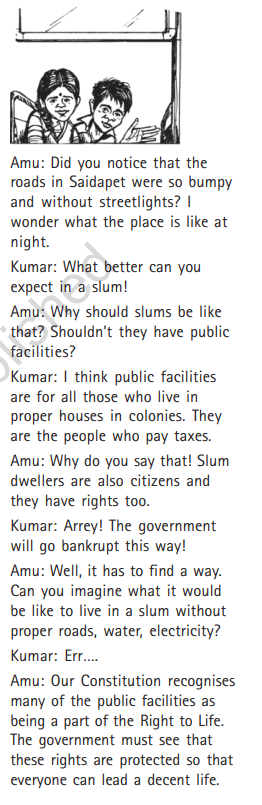
Question 7:Whose point of view do you agree with?
Answer :
We agree with the Amu’s point of view that is our Constitution recognises many of the public facilities as being a part of the Right to Life. The government must see that these rights are protected so that everyone can lead a decent life.
Question 8: What are public facilities? Why should the government be responsible for providing public facilities?
Answer : There are essential facilities that need to be provided for everyone. For example, water, health care, and sanitation, electricity, public transport, schools, and colleges. These are known as public facilities Public facilities relate to people’s basic needs. Any modern society requires these facilities. The Right to Life that the constitution guarantees is for all persons living in this country. The responsibility to provide public facilities, therefore, must be of the government.
Question 9: The government can get private companies to deliver some of the public facilities. For instance, contracts for building roads are given to private contractors. The distribution of electricity in Delhi is done by two private companies. However, the government must keep a close watch on these and ensure that they fulfill their commitment to reach these facilities to all people and at affordable prices.
Why do you think the government must assume the overall responsibility for public facilities even when it gets private companies to do part of the job?
Answer :The government must assume the overall responsibility for public facilities even when it gets private companies to do part of the job. This has the following reasons:
- The private companies may provide public facilities only at a high price.
- If people are not provided with public facilities at an affordable price, it means they are deprived of the opportunity to live a decent life.
Question 10: Look at your water bill and find out what the minimum rate is for municipal water in your area. Does the rate increase as the use of water increases? Why do you think the government charges a higher rate for greater use of water?
Answer :
Mininmum rate for muncipal water in my area is around 2/- per can.
Yes, the rate increases as the use of water increases. It is quite obvious that for greater use of water government will charge a higher rate. It is also a way to control the increased consumption of water. People will fix a limit for the usage of water so that the amount of bill does not exceed.
Question 11: Find out the various kinds of taxes people pay to the government by talking to a salariedperson, a person running his or her own factory/business and a shopkeeper. Share yourfindings in the classroom with your teacher
Answer : The various kinds of taxes people pay to the government are :
- Income tax
- Excise duty
- Sales tax
- Service tax
Question 12: Buses are the most important forms of public transport over short distances. It is the main link to the workplace for majority of the working people. With rapid urbanisation, the public bus system even in the major cities has not been able to keep up with the demand. As an alternative, the government has planned ambitious metro rail projects for Delhi and other metropolitan cities. Rs 11,000 crore was spent from the government budget for the construction of the first segment of the metro-rail in Delhi using the latest technology. People have pointed out that this massive expenditure could have been avoided if only a fraction of this amount was spent on upgrading the public bus system. Would you agree? What do you think could be the solution for other regions of India?
Answer :
i) I would agree with this point because we can save a lot of public property so that we can use it for other emergency uses.
ii) For other regions, depend upon the location and climate suitable transport materials should be used like Railways, Buses and drones etc...
Question 13: Discuss: Do you think this would be the right step? What do you think would happen if the(government withdraws from the task of supplying water?
Answer :
- The task of water supply should not be handed over to private companies.
- If the government withdraws from the task of supplying water, there could be a steep rise in the price of water making it unaffordable for many. It could lead to great unrest in the country. People will come out on the roads and protest against private companies.
Question 14: Discuss the main ideas in the above section. What do you think can be done to improve the water supply?
Answer : Transferring the responsibility of water supply from the government to private companies is not the solution to improve the water supply.
There are several other ways to improve the water supply. Some of them are as follows :
- Regular checking of water pipes through which water is supplied to the residential areas. If leakages are found, they should be repaired immediately.
- People must be made aware of water conservation.
- With the help of media, people must be taught the various ways of water conservation.
- People must be taught that through conserving water it is they will get benefit from it.
- Rainwater harvesting has been made popularised among the masses.
- There should be a check on the unequal distribution of Municipal water especially at the time of water shortage by the government authorities.
Question 15: Do you think it is also important to conserve resources like water and electricity and to use more public transport?
Answer : It is important to conserve resources like water and electricity because it will not lead to their shortages at the time of need. It is also important to use more-public transport to conserve fuel, avoid traffic jams, etc.
Question 16: Do you think that -lack of access to proper sanitation facilities affects peoples’ lives? How?
Answer : Lack of access to proper sanitation facilities do affect peoples’ lives in the following ways :
- It gives rise to various water-borne and air-borne diseases.
- It deteriorates the environment.
- Various germs or bacteria germinate in dirty areas and lead to infectious diseases.
Question 17: Why do you think that this would impact women and girls more acutely?
Answer : It is the poor who lack access to sanitation. It mainly affects women and girls more acutely because males or boys belonging to the poor class generally go out for work whereas females look after the household work. Since they spend most of their time in filthy conditions so they become victims of an unhealthy environment.
Exercises
Question 1: Why do you think there are so few cases of private water supply in the world?
Answer : There are very few cases of private water supply in the world because water is an essential amenity.
Water supply is a public facility that every government must provide to all citizens of a State. In cases where water supply was placed in the hands of private companies, the prices of water rose, making it unaffordable to the masses. This resulted in riots, protests and violent demonstrations in countries like Bolivia. Hence, it has been deemed best that the government must handle water supply services.
Question 2: Do you think water in Chennai is available to and affordable by all? Discuss.
Answer : Water in Chennai is not available to and affordable by all. Availability of a good, regular water supply is proportionate to the level of income one earns, in this city. Senior government officials in areas like AnnamNagar can get a whole water tanker arranged for themselves; most areas like Mylapore get water once in two days; in Madipakkam, people buy bottled water for drinking purposes but the situation is the worst inmslums. Here, water supply runs for barely an hour everyday from a single tap serving over thirty families for all their water needs.
Question 3:How is the sale of water by farmers to water dealers in Chennai affecting the local people? Do you think local people can object to such exploitation of ground water? Can the government do anything in this regard?
Answer : The sale of water by farmers to water dealers in Chennai is affecting the local people in various ways:
- The water they are taking away is for irrigation of agriculture. Because of this exploitation irrigation and so, agriculture is bound to suffer.
- This water is also for general supply and drinking purpose of the villagers.
- As a result of the heavy exploitation of water, the ground water levels dropped drastically in these areas.
Yes, the local people can object to such heavy exploitation of ground water since it is a public facility or nature’s gift on which everyone has equal right and so nobody can sell or take away exclusively.
Yes, the Government needs to play a crucial role to find out a suitable alternative in this regard. Our Constitution recognizes many of the public facilities including access to safe drinking water, as being a part of the Right to Life. So, the Government must see that these rights are protected so that everyone can lead a decent life.
Question 4: Why are most of the private hospitals and private schools located in major cities and not in towns or rural areas?
Answer : The distribution of public facilities in our country is inadequate and largely unfair.
For example, urban areas are provided with and consume more electricity than villages or townships. Most metropolitan cities consume vast amounts of power for market-places, multiplexes and air- conditioning while villages and towns bear huge power-cuts even in summer so much so that there is no electricity available to them for domestic purposes too. This is a gap in the distribution of just one of the public facilities provided by the government.
Question 5: Do you think the distribution of public facilities in our country is adequate and fair? Give an example of your own to explain.
Answer : The distribution of public facilities in our country is neither adequate nor fair. For example, the Delhites avail all public facilities like water, healthcare and sanitation, electricity, public transport, schools, and colleges. But if we go a few kilometers away, for example, Mathura or Aligarh people face grave crises of public facilities. Electricity cut-off, water shortages are a normal routine of life. Public transport is also not properly developed.
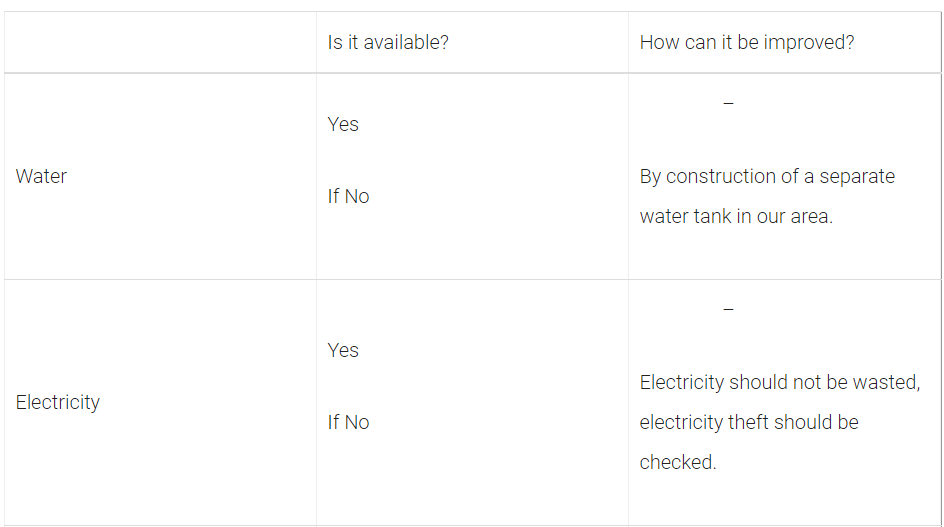
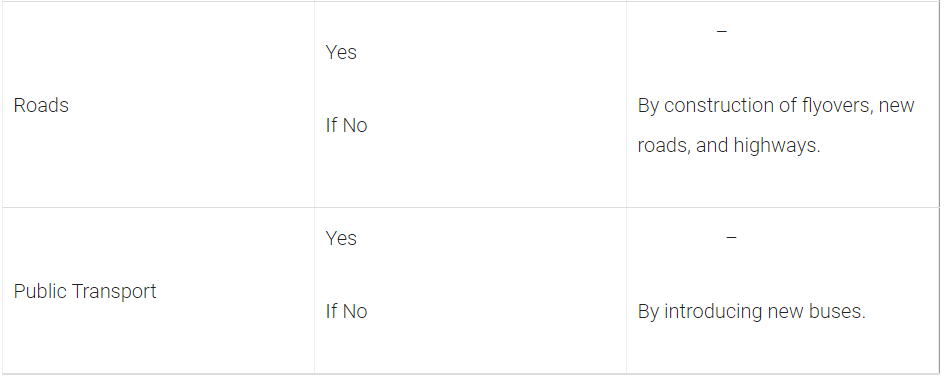
Question 6: Take some of the public facilities in your area, such as water, electricity, etc. Is there scope to improve these? What in your opinion should be done? Complete the table.
Answer :
Question 7: Are the above public facilities shared equally by all the people in your area? Elaborate.
Answer :No, the above public facilities are not shared equally by all the people in our area.
- People, livings in the slum area, are getting very few facilities.
- Municipal supply meets only about half of the needs.
- For the remaining half people take the help of private means.
- Public facilities like healthcare facilities are now being charged. The poor fail to get these facilities.
- Due to rush most of the people do not avail of governmental public facilities like healthcare, etc.
Question 8: Data on some of the public facilities are collected as part of the Census. Discuss with your teacher when and how the Census is conducted.
Answer : Census is conducted after every ten years. For conducting census the government officials, teachers are deputed to collect the data from every house. Deputed officials are provided a questionnaire which has to be filled by them according to information they get from people. The old data are deleted and new data are included.
Question 9: Private educational institutions - schools, colleges, universities, technical and vocational training institutes are coming up in our country in a big way. On the other hand, educational institutes run by the government are becoming relatively less important. What do you think would be the impact of this? Discuss.
Answer : Private educational institutions levy very high fees, which only affluent people can afford. So quality education will be the right of only the rich. If educational institutions run by the government are not up to the mark, the weaker sections of the society are deprived of quality education. The end result of this disparity will be that only the rich will get good education while the poor will be deprived of it.